Services Overview
What Is the Difference Between IEC and NEMA Motor Mounting?
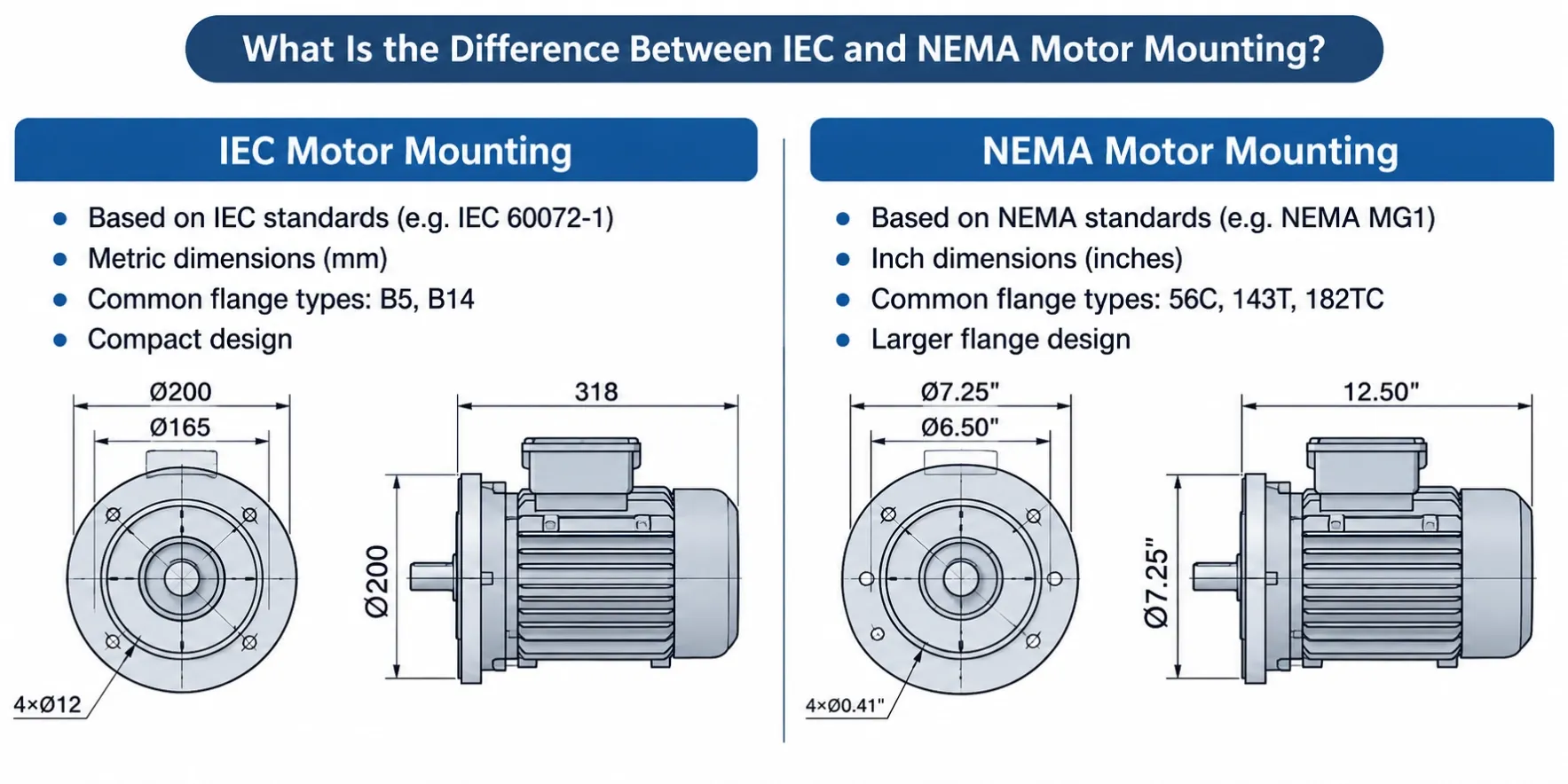
When selecting an electric motor for industrial machinery, one important consideration is the motor mounting standard.
Two commonly used systems are IEC and NEMA. Both define motor dimensions and mounting interfaces, but they use different dimensional systems and specifications.
Understanding the difference is particularly important when connecting a motor to a gearbox, replacing an existing motor, or sourcing equipment from different manufacturers.
A motor may have the correct power and speed but still fail to fit the gearbox because its mounting dimensions or shaft configuration are different.
So, what is the difference between IEC and NEMA motor mounting? And can an IEC motor be installed on a NEMA gearbox?
This article explains their key differences and provides practical guidance for motor and gearbox selection.
1. What Is IEC Motor Mounting?
IEC stands for the International Electrotechnical Commission.
IEC motor dimensions are widely used across Europe, Asia, and many other international markets.
IEC standards define important motor dimensions, including:
- Motor frame size
- Shaft diameter and extension length
- Shaft height
- Flange dimensions
- Mounting hole positions
- Other mechanical interface dimensions
IEC motor frame sizes are generally expressed in metric units.
For example, common IEC motor frame sizes include:
- IEC 63
- IEC 71
- IEC 80
- IEC 90
- IEC 100
- IEC 112
- IEC 132
- IEC 160
The frame number generally corresponds to the shaft center height in millimeters for standard foot-mounted motors.
IEC motors are commonly available with different mounting arrangements, such as B3, B5, and B14.
These configurations determine how the motor is installed and connected to the driven equipment.
2. What Is NEMA Motor Mounting?
NEMA stands for the National Electrical Manufacturers Association.
NEMA motor standards are widely used in the United States, Canada, and other markets that follow North American motor specifications.
NEMA defines motor frame dimensions and mechanical mounting interfaces, including:
- Frame dimensions
- Shaft diameter and extension
- Mounting hole positions
- Flange dimensions
- Shaft height
- Other mechanical characteristics
NEMA motor frame sizes are commonly identified by numbers such as:
- NEMA 56
- NEMA 143T
- NEMA 145T
- NEMA 182T
- NEMA 184T
- NEMA 213T
- NEMA 215T
- NEMA 254T
Unlike IEC frame sizes, NEMA frame designations do not directly represent shaft center height in millimeters.
NEMA motors are commonly specified using horsepower (HP), while IEC motors are commonly specified using kilowatts (kW). However, both systems can use either unit when specifying motor power.
NEMA motors also commonly feature mounting interfaces such as C-face and D-flange configurations.
3. IEC vs NEMA Motor Mounting: Key Differences
The main differences between IEC and NEMA motor mounting can be summarized as follows:
Feature | IEC Motor | NEMA Motor |
|---|---|---|
Main standard | IEC | NEMA |
Common markets | Europe, Asia, international markets | North America |
Dimensional system | Primarily metric | Primarily imperial |
Frame designation | 63, 71, 80, 90, 100, etc. | 56, 143T, 145T, 182T, etc. |
Power rating convention | Commonly kW | Commonly HP |
Mounting arrangements | B3, B5, B14, etc. | Foot-mounted, C-face, D-flange, etc. |
Shaft dimensions | Defined by IEC specifications | Defined by NEMA specifications |
Mounting dimensions | IEC dimensional standards | NEMA dimensional standards |
Although both systems serve the same basic purpose, their dimensions and mounting interfaces are not automatically interchangeable.
A motor with similar power and speed may still have different shaft dimensions, flange diameters, or mounting hole positions.
4. Understanding IEC Motor Mounting Types
IEC motors are available in several standard mounting arrangements.
The most common configurations include B3, B5, and B14.
4.1 B3: Foot-Mounted Motor
A B3 motor is installed using mounting feet attached to the motor housing.
This configuration is commonly used in industrial machinery where the motor is mounted on a base, frame, or gearbox support.
Typical applications include:
- Pumps
- Fans
- Conveyors
- General industrial machinery
4.2 B5: Large-Flange Motor
A B5 motor uses a large mounting flange for direct connection to equipment.
It is commonly used when the motor needs to be mounted directly onto a gearbox or machine housing.
The flange dimensions and mounting hole arrangement must match the corresponding equipment.
4.3 B14: Small-Flange Motor
A B14 motor uses a smaller mounting flange than a B5 motor.
It is frequently used with compact gearboxes and equipment where installation space is limited.
B14 configurations are often found in small industrial gear motors and automation equipment.
5. Understanding NEMA Motor Mounting Types
NEMA motors also have different mounting configurations.
Two commonly used flange types are C-face and D-flange.
5.1 NEMA C-Face
A C-face motor has a flange with threaded mounting holes.
It is designed for direct mounting to compatible equipment, such as gearboxes, pumps, and other driven machinery.
C-face motors are widely used in industrial applications where a compact and secure motor-to-equipment connection is required.
5.2 NEMA D-Flange
A D-flange motor uses a different flange arrangement, generally featuring through-holes for mounting.
It is commonly used in applications requiring a flange-mounted motor connection.
C-face and D-flange motors are not interchangeable simply because they have similar power ratings or frame designations.
Their flange dimensions, mounting details, and shaft configurations must be checked.
6. Can an IEC Motor Replace a NEMA Motor?
Yes, an IEC motor can sometimes replace a NEMA motor, but it is not necessarily a direct replacement.
The motor's mechanical interface must be checked before installation.
Important dimensions include:
- Shaft diameter
- Shaft extension length
- Shaft key dimensions
- Flange outside diameter
- Flange pilot diameter
- Mounting hole positions
- Bolt-hole dimensions
- Shaft center height, where applicable
For example, an IEC 90-frame motor and a NEMA 143T motor may have similar power ratings in certain configurations.
However, this does not mean they have identical mounting dimensions.
Even if their rated power and speed are similar, differences in shaft and flange dimensions may prevent direct installation.
Depending on the application, a suitable adapter flange or customized mounting solution may allow the two systems to work together.
The final decision should always be based on dimensional drawings rather than frame-size comparisons alone.
7. IEC and NEMA Motor Compatibility with Gearboxes
Motor mounting compatibility is particularly important when selecting or replacing an industrial gearbox.
Many gearbox manufacturers offer both IEC and NEMA motor adapters.
For example, a gearbox may be supplied with:
- IEC B5 motor adapter
- IEC B14 motor adapter
- NEMA C-face motor adapter
- NEMA D-flange motor adapter
These adapters allow compatible motors to be connected to the gearbox.
However, selecting the correct adapter is only part of the process.
The following details should also be checked:
Motor frame: Confirm the motor frame size and corresponding mounting dimensions.
Flange type: Verify whether the motor uses an IEC B5, B14, NEMA C-face, or NEMA D-flange connection.
Input shaft: Check the shaft diameter, length, and keyway dimensions.
Adapter dimensions: Confirm that the adapter is designed for the specific motor and gearbox combination.
Motor power and torque: Make sure the gearbox can handle the motor's actual operating requirements.
A correct mounting connection does not automatically guarantee that the gearbox is suitable for the motor's power and torque.
8. Common Mistakes When Choosing IEC and NEMA Motors
Several mistakes can cause problems during motor replacement or gearbox installation.
Mistake 1: Matching Only Motor Power
A 2 HP motor and a 1.5 kW motor have approximately similar power ratings.
However, similar power does not mean identical dimensions or mounting interfaces.
Mistake 2: Assuming Frame Sizes Are Equivalent
IEC and NEMA use different frame designation systems.
An IEC 90-frame motor should not automatically be considered equivalent to a particular NEMA frame.
Always compare the actual dimensional drawings.
Mistake 3: Ignoring the Flange Type
An IEC B5 motor, IEC B14 motor, NEMA C-face motor, and NEMA D-flange motor have different mounting interfaces.
Choosing the wrong configuration can result in installation problems.
Mistake 4: Overlooking Shaft Dimensions
Even when the flange dimensions match, differences in shaft diameter, extension length, or keyway dimensions may prevent proper connection.
Mistake 5: Ignoring Electrical Requirements
Mechanical compatibility is only one part of motor selection.
Voltage, frequency, phase, insulation class, protection rating, and operating conditions should also be checked.
9. What Information Is Needed to Select the Correct Motor Adapter?
If you need to connect an IEC or NEMA motor to a gearbox, prepare the following information:
- Motor manufacturer and model
- Motor power (kW or HP)
- Motor speed (RPM)
- IEC or NEMA frame size
- Mounting type
- Flange dimensions
- Shaft diameter and extension length
- Keyway dimensions
- Gearbox model
- Required installation arrangement
A motor nameplate photo and dimensional drawing are particularly useful.
If the original drawing is unavailable, clear photos and accurate measurements can help the manufacturer identify the appropriate adapter.
10. Which Motor Mounting Standard Should You Choose?
There is no universal answer to whether IEC or NEMA is better.
The right choice depends on the equipment design, market requirements, existing machinery, and available components.
IEC motors may be preferred when:
- The equipment follows international IEC specifications.
- The existing gearbox uses an IEC motor adapter.
- Metric mounting dimensions are required.
- The machine is designed around IEC motor configurations.
NEMA motors may be preferred when:
- The equipment is designed for the North American market.
- The existing installation uses NEMA mounting dimensions.
- A NEMA C-face or D-flange connection is required.
- Replacement components need to match an existing NEMA motor interface.
For gearbox manufacturers and equipment builders serving international markets, offering both IEC and NEMA motor connection options can make product integration easier.
Conclusion
IEC and NEMA are two widely used motor dimensional and mounting standards.
IEC motors generally use metric dimensions and frame designations such as 80, 90, and 100, while NEMA motors use frame designations such as 56, 143T, and 145T.
Their mounting arrangements, shaft dimensions, flange configurations, and dimensional requirements are different.
When selecting a motor for a gearbox or replacing an existing motor, do not rely on power ratings or frame numbers alone.
Always verify the shaft dimensions, flange type, mounting holes, and adapter specifications.
The right motor connection is not simply about whether the motor can be attached to the gearbox. It is about ensuring that the mechanical interface, electrical specifications, and operating requirements are all compatible.