Jun 26, 2026Services Overview
What Is Gearbox Efficiency? A Complete Guide for Industrial Applications
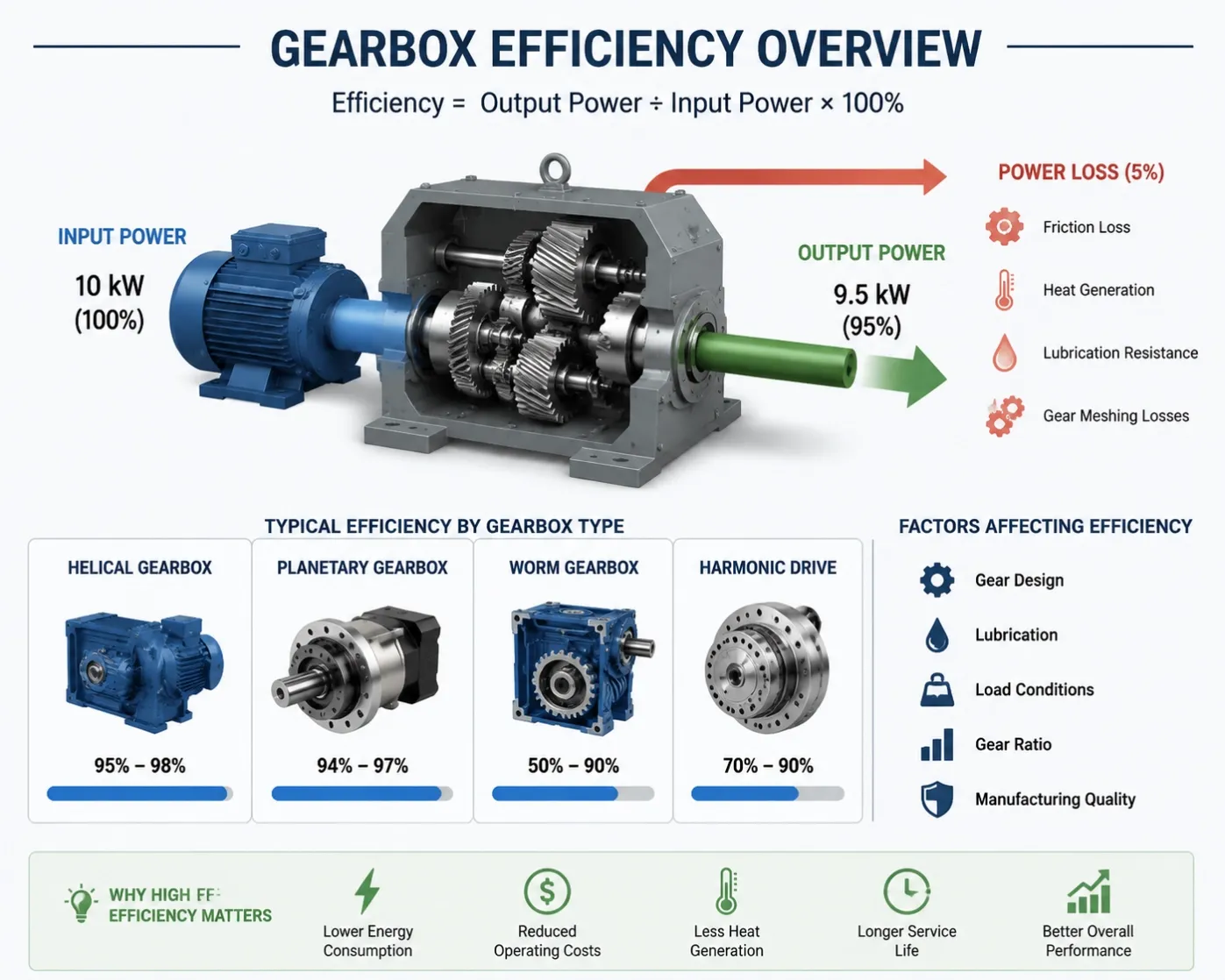
Gearbox efficiency shows power conversion from input to output. Higher efficiency means less loss and heat. Helical 95–98%, planetary 94–97%, worm varies. It depends on design, lubrication, and load.
What Is Gearbox Efficiency? A Complete Guide for Industrial Applications
Gearbox efficiency is one of the most important factors when selecting a speed reducer for industrial equipment. Higher efficiency means less energy loss, lower operating costs, reduced heat generation, and longer service life.
But what exactly is gearbox efficiency, and why should buyers pay attention to it?
What Is Gearbox Efficiency?
Gearbox efficiency refers to the percentage of input power that is successfully transmitted to the output shaft.
The efficiency can be calculated using the following formula:
Gearbox Efficiency (%) = Output Power ÷ Input Power × 100
For example, if a motor delivers 10 kW of power to a gearbox and the gearbox outputs 9.5 kW, the efficiency is 95%.
The remaining 5% is typically lost through friction, heat, lubrication resistance, and gear meshing losses.
Why Is Gearbox Efficiency Important?
A gearbox with higher efficiency provides several benefits:
- Lower energy consumption
- Reduced operating costs
- Less heat generation
- Longer lubricant life
- Improved machine performance
- Extended gearbox service life
For equipment operating continuously, even a small increase in efficiency can lead to significant energy savings over time.
Typical Efficiency of Different Gearbox Types
Helical Gearboxes
Helical gearboxes are among the most efficient transmission systems available.
Typical efficiency:
95% – 98%
They are commonly used in conveyors, packaging machinery, material handling systems, and industrial automation.
Worm Gearboxes
Worm gearboxes are compact and economical but generally have lower efficiency.
Typical efficiency:
50% – 90%
Efficiency depends heavily on the reduction ratio and operating conditions.
Planetary Gearboxes
Planetary gearboxes offer high torque density and excellent efficiency.
Typical efficiency:
94% – 97%
They are widely used in servo systems, robotics, and precision machinery.
Harmonic Drive Gearboxes
Harmonic gearboxes provide high positioning accuracy with compact dimensions.
Typical efficiency:
70% – 90%
These gearboxes are commonly used in robotics and automation equipment.
What Factors Affect Gearbox Efficiency?
Several factors influence gearbox performance:
Gear Design
Precision-machined gears create less friction and improve power transmission.
Lubrication
Proper lubrication reduces wear and minimizes energy loss.
Load Conditions
Most gearboxes operate most efficiently near their rated load range.
Gear Ratio
Higher reduction ratios can increase internal losses and reduce efficiency.
Manufacturing Quality
High-quality materials, precision grinding, and accurate assembly all contribute to improved efficiency.
How to Improve Gearbox Efficiency
To maximize gearbox performance:
- Select the correct gearbox type for the application
- Avoid oversized gearboxes
- Use recommended lubricants
- Perform regular maintenance
- Ensure proper alignment between motor and gearbox
- Choose precision-manufactured gears
Choosing the Right Gearbox
Efficiency should never be the only selection criterion. Buyers should also consider:
- Required output torque
- Speed ratio
- Installation space
- Operating environment
- Duty cycle
- Maintenance requirements
A gearbox with slightly lower efficiency may still be the best choice if it provides better torque capacity or cost advantages for the application.
Conclusion
Gearbox efficiency directly affects energy consumption, operating costs, and equipment reliability. Understanding efficiency ratings helps engineers and buyers choose the most suitable gearbox for their machinery.
Whether selecting a helical gearbox, worm gearbox, planetary gearbox, or harmonic drive, evaluating efficiency alongside torque, ratio, and application requirements will help ensure long-term performance and value.